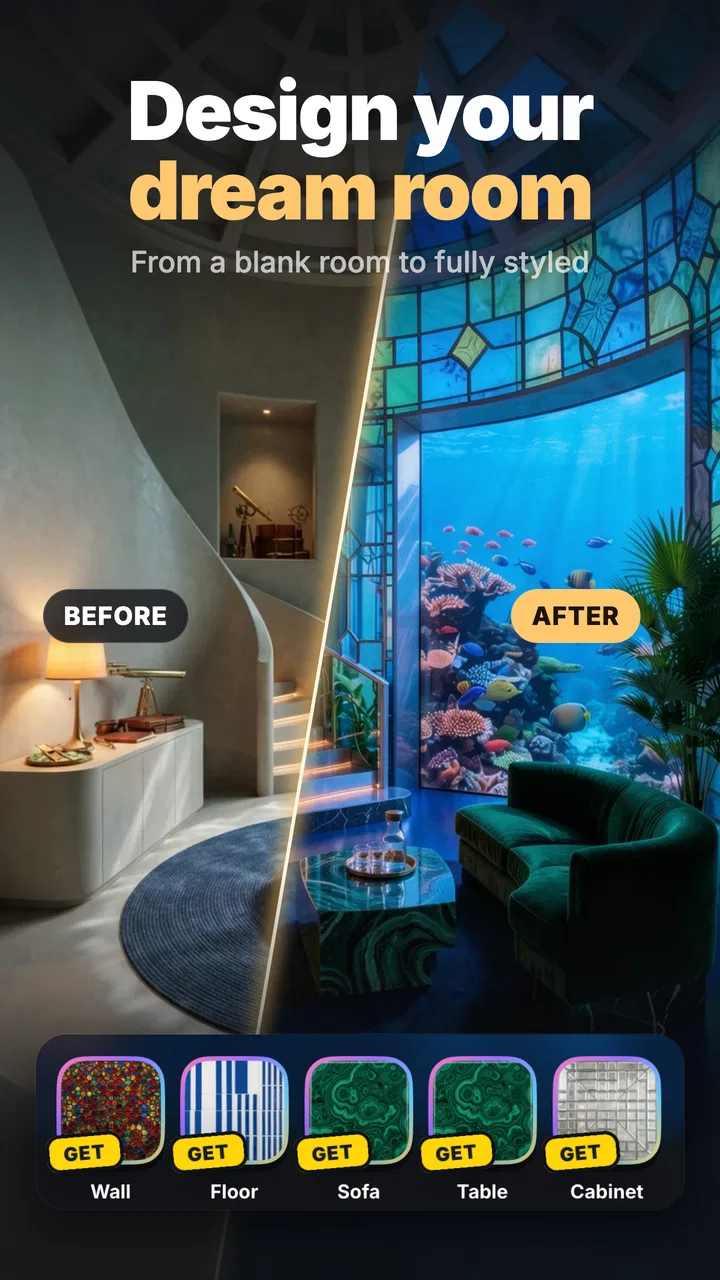
Aesthetic - Decorate & Design
- 4.7
- Rating
- 10.00K
- Installs
- Free
- Price

 Analysis by App-foxy
I spent time with Aesthetic - Decorate & Design because its central idea is easy to understand but surprisingly hard to execute well: you create attractive rooms, make design decisions, and let your taste compete with other players. That focus makes it a casual game rather than a serious interior-design tool, yet it still gives each choice enough weight to make a room feel personal. I found myself opening it for short creative breaks, then staying longer when I wanted to refine a space instead of simply tapping through a challenge.
Developed by Fliq Lab, the game is free to download and suitable for Everyone. It has a 4.7 average from around 1.7 thousand ratings, with more than 10 thousand installs. Those figures suggest a healthy early audience, although the experience feels more like a focused design playground than a huge social platform. Its store summary points to room creation, worldwide competition, and ranking progress, while the brief store description reduces the idea to one word: “Aesthetic.” That is actually a useful clue. The appeal depends less on complicated rules and more on whether you enjoy judging color, balance, mood, and visual harmony.
Why the room-design challenge is the real game
The strongest verified capability here is the ability to design rooms and then place your work in a competitive setting. In my experience, that combination changes the way I make decisions. If I were decorating only for myself, I could choose the brightest item, the most dramatic color, or whatever looked interesting in isolation. Aesthetic encourages a more complete question: does this object help the whole room look intentional?
You May Also Like

 AccuWeather: Weather Radar
AccuWeather Review: A Quick, Clear Forecast for Everyday Decisions
For everyday plans, the best forecast is the one you can understand quickly. AccuWeather makes rain timing, radar, and local conditions easy to act on, with a few trade-offs.

 Hill Climb Racing
Why Hill Climb Racing Still Turns Crashes Into One More Run
A tiny car, a bumpy hill and one more upgrade: Hill Climb Racing keeps resurfacing because its simple chaos makes every near-miss feel personal.

 AliExpress - Shopping App
AliExpress Makes Global Shopping Feel Personal, but Shoppers Bear the Risk
AliExpress turns a global marketplace into a pocket-sized discovery engine. Its reach is useful, its shopping loop compelling, and its trade-offs easy to miss.

 Lords Mobile: Kingdom Wars
Lords Mobile Is a Kingdom-Building Routine, Not a Quick Match
A case-by-case verdict on the building, battles, device demands, and social commitments that make Lords Mobile rewarding for some players and exhausting for others.

 PDF Scanner app - TapScanner
TapScanner Makes Paperwork Easier to Capture, Check, and Share
TapScanner makes scanning with a phone feel less like a rescue operation and more like a dependable step in getting work done. Its capture tools are useful, though not flawless.

 Block Blast!
 Shows How Much a Puzzle Game Can Leave Out
A quiet grid game shows why puzzle players increasingly value instant clarity, repeatable skill and low-pressure play—and where the genre still needs to catch up.
More From Our News Desk
View All News


That distinction matters. Many casual decorating games are essentially collection screens with a room placed behind them. The fun comes from unlocking more items, and the design itself can become secondary. Here, the room is the point of attention. I look at the arrangement as a composition, not just a checklist. A sofa, wall treatment, table, and decoration need to support the same mood, even when the available choices tempt me in different directions.
The competitive layer also gives ordinary choices a consequence. A room can be technically full and still feel unfinished. Another can use fewer noticeable pieces but look more convincing because the colors and proportions agree. When I compare alternatives, I pay attention to visual hierarchy: what should my eye notice first, what should sit quietly in the background, and whether one item is overpowering everything around it.
The most useful mindset is to design the room as one picture, not as a pile of individually attractive objects. That sounds obvious, but it is the difference between a result that feels coherent and one that feels busy. I began making better decisions when I stopped asking whether I liked each item by itself and started asking whether it belonged beside the other choices.
How I approach a new room
I usually begin with the largest visual anchors. Walls, flooring, major furniture, and the dominant color direction establish the room before small decorations have any chance to help. If I start with accessories, I can become attached to details that later force the rest of the design into an awkward shape. Working from large elements toward smaller ones makes the process calmer and reduces unnecessary changes.
My next step is to choose a mood rather than a strict theme. Warm and relaxed, clean and restrained, playful, dramatic, or soft are more useful starting points than trying to force every object into one narrow style. This gives me room to adapt when a preferred item does not fit perfectly. A design can have contrast without losing unity; it simply needs a reason for the contrast to exist.
I then inspect the room from a distance before making final choices. Small details often look appealing when I focus on them, but they may disappear in the overall composition. Conversely, one strong color can dominate the entire result. This is where the game’s simple premise becomes a useful creative exercise: I have to judge the room as a viewer, not only as the person who selected every part.
One practical tip is to keep a deliberate “quiet” area. Not every surface needs a bold object. Leaving some visual breathing room can make the main feature more noticeable and helps prevent a room from looking like every available option was added. This is especially important when competing with other designs, because a clear focal point is easier to understand than a crowded arrangement.
Competition changes the way I decorate
The worldwide competition and ranking angle make the game more than a private decorating notebook. I do not treat a ranking result as a definitive judgment of taste, because visual preferences vary and a competitive result can favor readability over subtlety. Still, comparing my work with other players gives me a practical lesson: a room has to communicate quickly.
That does not mean choosing the loudest possible design. It means making the intended mood visible without requiring a long explanation. If I want a calm room, the palette and main furniture should support that immediately. If I want something energetic, a single bright accent may be more effective than several unrelated colors. The competitive setting rewards decisions that can be understood at a glance.
I also find that ranking pressure can expose weak choices. An item may be one of my favorites but still distract from the room. When that happens, I have to decide whether personal preference or overall balance matters more. That tradeoff is one of the better parts of the experience, because it turns casual play into a small design critique. I am not merely decorating; I am learning which choices survive when viewed as part of a complete scene.
How it works in an everyday play session
Aesthetic fits naturally into short sessions. I can approach it when I have a few spare minutes and make meaningful progress without needing to memorize a complicated control scheme. The basic loop is familiar: work on a room, make visual decisions, and see how the finished design performs in the competitive environment. The simplicity is a strength for casual players, especially anyone who wants creativity without the management burden found in larger simulation games.
At the same time, the simplicity means the game’s satisfaction depends on how much I enjoy visual judgment. Someone looking for action, narrative, puzzles, or deep resource planning will not find the same kind of variety here. The challenge is primarily aesthetic. I decide, compare, revise, and evaluate. That is enough for me when I want a relaxing creative task, but it will not replace a more systems-heavy game.
A realistic everyday use case is a short evening break after work or study. I can open the game with a simple goal: finish one room without constantly changing direction. I choose a broad mood, establish the largest pieces, add only the details that reinforce the mood, and stop when the design looks balanced. That routine makes the game feel satisfying without turning it into an obligation. It is also a good way to avoid overdecorating, since a time-limited session encourages decisive choices.
Another useful routine is to use a room as a visual experiment. Instead of trying to create the perfect result immediately, I can test a restrained palette in one attempt and a stronger contrast in another. The competitive outcome then becomes feedback about communication and balance, not a reason to copy whatever seems popular. This approach gives the game more longevity than simply chasing the most noticeable decoration.
What separates it from other casual design games
Compared with a traditional home-building simulator, this game is more approachable because it centers the act of making a room look good rather than asking me to manage an entire household, budget, or long-term property. That makes it easier to pick up, but it also means there is less room for players who enjoy detailed construction systems and practical planning.
Compared with a collection-focused decorating game, the competitive setting gives visual decisions more purpose. I am not only gathering attractive pieces for the sake of ownership; I am considering how they work together and how another viewer might respond. Compared with a social design app, however, the experience is still fundamentally a game. I approach the room with a goal and an outcome in mind, rather than using it purely as a portfolio or mood board.
This positioning is important before downloading. If you want a calm, accessible design challenge with a clear visual objective, Aesthetic has a sensible identity. If you want accurate interior-planning tools, precise measurements, professional furniture catalogs, or a realistic renovation workflow, a dedicated design application will be a better choice. The game succeeds when I treat it as expressive play, not as a substitute for planning a real room.
The tradeoffs behind the free entry point
The game is free, which makes it easy to try without committing money first. It also includes in-app purchases ranging from $1.99 to $99.99 per item. That range is worth considering before becoming invested. I would approach the purchase system carefully and decide in advance whether I am comfortable spending anything, because a free decorating game can become less relaxing if I start feeling that progress depends on buying more content.
My advice is to judge the basic creative loop before spending. Play long enough to learn whether choosing palettes and arranging rooms genuinely holds your attention. If the design process itself is enjoyable, optional spending can remain a personal choice rather than the reason to continue. If the room-making feels repetitive without additional items, paying more may not solve the underlying problem.
The competitive side creates another tradeoff. Rankings can motivate experimentation, but they can also make a subjective activity feel like a score chase. I recommend using results as a prompt to reconsider composition rather than treating them as a verdict on personal taste. A lower result may reveal an unclear focal point, but it does not automatically mean a bold or unusual idea was wrong.
The age rating of Everyone makes the game broadly approachable, including for younger players who enjoy color and decoration. Adults should still decide whether the competitive element and optional purchases suit the person using the device. For a family setting, I would explain that a ranking is feedback inside a game, not an objective measure of creativity, and I would set spending boundaries before handing over the device.
Small techniques that improve the results
My first technique is to limit the number of competing accents. When several colors demand attention, I choose one primary accent and let the rest support it. This does not make every room bland; it makes the strongest choice easier to see. A restrained background can make a single expressive object feel more deliberate.
My second technique is to check repetition. Repeating a color or material in two separate areas can connect the room, while repeating it everywhere can flatten the design. I look for a relationship between the main furniture and one or two smaller details, then avoid echoing the same visual note in every corner.
My third technique is to remove something before adding something else. In a decorating game, the instinct is usually to fill an empty area. I have found that taking away a distracting item often improves the room more than adding another decoration. This is a useful test when the result feels cluttered but I cannot identify why.
A fourth technique is to make decisions in passes. First I solve the overall structure, then color balance, then detail. Changing all three at once makes it hard to understand what improved or damaged the design. Separating those passes turns trial and error into a more controlled process and helps me learn from each room.
Who will enjoy it most
I think Aesthetic is best for players who like visual creativity but do not want a demanding simulation. It suits someone who enjoys arranging a scene, comparing styles, and polishing a result in short sessions. It is also a good fit for players who like gentle competition: the ranking element adds direction without changing the game into a fast or stressful contest.
It may appeal to people who already enjoy mood boards, room inspiration, color matching, or casual customization. The game gives those interests a playable structure. Instead of endlessly browsing ideas, I have to commit to a design and see whether it communicates effectively. That commitment is where much of the learning happens.
I would be more cautious about recommending it to someone who needs a deep progression system, realistic construction, or a strong story. The design challenge is the attraction, so players who do not naturally notice color harmony, spacing, and visual emphasis may run out of interest sooner. I would also skip it if competitive comparison makes creative activities unpleasant, since the ranking layer is part of the game’s identity rather than a minor extra.
Device compatibility is relatively broad: the current version is 6.4.0 and requires Android 7.0 or later. That makes it accessible to many Android users, though I would still keep the system and store software updated for the smoothest experience. The game is categorized as Casual, and that label fits its low-friction structure, but the best results come from paying attention rather than tapping randomly.
My recommendation after playing
Fliq Lab has chosen a narrow concept and made the room itself the main source of satisfaction. I like that focus. The game does not need a complicated premise when the decisions are clear enough to invite experimentation. Its strongest moment is the point when I stop selecting objects individually and begin shaping a complete visual statement.
The free entry makes trying it straightforward, while the in-app purchase range means I would keep a clear spending limit and evaluate the core loop first. The competitive format can be motivating, but I would treat rankings as useful feedback rather than a final judgment. Players who want a relaxed creative challenge should find plenty to appreciate, especially if they enjoy refining small details and learning from comparison.
My final view is positive, with a specific recommendation: choose this game if you want to design rooms for the pleasure of making them feel coherent, then test that judgment against other players. Do not choose it expecting a full interior-design simulator or a broad management game. For the right audience, Aesthetic - Decorate & Design turns a simple room into a compact creative problem, and that is exactly why I kept returning to it.
FAQs for Aesthetic - Decorate & Design
01What is Aesthetic - Decorate & Design?
Aesthetic - Decorate & Design is a creative decorating game focused on arranging and styling attractive rooms, spaces, and visual scenes. It lets you experiment with furniture, colors, decorations, and different design themes while building an overall aesthetic. The experience is aimed at players who enjoy interior design, customization, and relaxing, visually pleasing gameplay rather than fast action or complicated controls.
02How does the decorating gameplay work?
The main gameplay involves selecting items and placing them within a room or design setting to create a look that matches your personal taste or a specific objective. You can usually combine furniture, accessories, colors, and decorative elements to improve the appearance of each space. The controls are simple and accessible, making the game suitable for casual players who want to create designs without needing previous interior-design experience.
03Is Aesthetic - Decorate & Design free to download?
The application can generally be downloaded without an initial purchase, but the exact business model may include advertisements, optional in-app purchases, or premium content. Some furniture, themes, design tools, or customization options may require additional payment or progression. Before downloading, it is worth checking the current store listing for pricing details, available subscriptions, advertising information, and the permissions requested by the app.
04Does the game require an internet connection?
Some features may work offline, particularly basic decorating activities that have already been downloaded, but an internet connection can be needed for advertisements, updates, cloud functionality, new content, or in-app purchases. Availability may also vary according to the version installed on your device. If you plan to play while traveling or without mobile data, test the main decorating features before relying on offline access.
05Is Aesthetic - Decorate & Design suitable for children?
The game is generally approachable for younger players because it focuses on decoration and creative choices instead of combat or complex competition. However, parents should still review the age rating, advertising, in-app purchase options, and privacy information before allowing children to use it. If the app includes external links, chat features, or paid items, parental controls and purchase restrictions are recommended for safer use.
Pros
- Easy-to-use tools make room decorating simple for beginners.
- Offers creative freedom to experiment with colors
- furniture
- and layouts.
- Relaxing gameplay provides an enjoyable way to unwind.
- Design challenges add variety beyond basic room decoration.
- Visual results are polished and satisfying to share.
Cons
- Some furniture and decoration options may require in-app purchases.
- Advanced design choices can feel limited compared with professional tools.
- Progress may depend on completing repetitive decorating tasks.
- The app may need a stable connection for certain features.
- Ads can interrupt the experience
- especially for free users.

Aesthetic - Decorate & Design
Gallery